
VoIP Numbers: What They Are & How to Detect Them
A VoIP number is a phone number that routes calls and texts over the internet instead of a carrier’s mobile or landline network — Google Voice, TextNow, and most Twilio endpoints are VoIP. To check whether a number is VoIP, run a line-type lookup: it queries carrier data and returns the line type, provider, and country without ringing the number.
A VoIP (Voice over IP) number dials real phones, receives real SMS codes, and looks completely ordinary in a contact list. Regulators treat these numbers as their own category — the FCC defines VoIP as a service that routes calls over the internet and connects with the public switched telephone network.
They are also the cheapest phone identity on the market. A disposable VoIP number costs a fraction of a SIM card, needs no contract, and in many cases no verified ID at all. That combination (real enough to pass a format check, cheap enough to burn by the thousand) is exactly why VoIP detection became a standard step in signup screening, list hygiene, and fraud review.
Below: what these numbers actually are, when they should worry you, and (if you came here to check a specific number) the fastest way to do that.
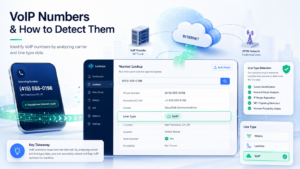
How a VoIP number differs from a mobile or landline number
Every phone number is an address in a national numbering plan. What differs is where the endpoint lives:
| Line type | Where calls land | Typical cost to obtain | Identity friction |
|---|---|---|---|
| Mobile | A SIM card on a carrier network | Moderate; often requires ID or a payment trace | High in markets with mandatory SIM registration |
| Landline | A fixed physical line | Moderate; tied to a premises | High; billing address and contract |
| VoIP | A cloud account, app, or SIP endpoint | Very low; often free or under a dollar | Low on many providers; varies by country and provider |
Two structural properties make VoIP numbers different in practice. First, portability: a VoIP number is not bound to a region code the way a landline is. A number with a +1 212 area code can be answered in Manila. Second, provisioning speed: an app can hand out a working number in under a minute, which is why "burner" behavior clusters overwhelmingly on VoIP lines.
Neither property is inherently bad. A distributed support team wants numbers that follow people, not desks. But both properties break assumptions that older fraud rules relied on — for example, "the area code matches the billing address" stopped holding up years ago. (If you only need a mobile-vs-landline read, the separate landline vs mobile vs VoIP lookup guide covers that narrower question.)
Why VoIP numbers dominate fake signups — and why that is not the whole story
Ask a risk team what a VoIP number correlates with and you will hear the same list: trial abuse, promo-code farming, fake marketplace accounts, and OTP interception setups. The economics explain it. If one signup earns a $10 welcome bonus, and a VoIP number costs a few cents, the fraud margin is enormous — and the numbers come with no contract to trace.
But the same numbers serve a large legitimate population:
- Remote and support teams. Business phone systems are VoIP almost everywhere now. A customer-success rep in one country answering a local number is normal operations, not a red flag.
- Privacy-conscious users. A second number for classifieds, dating, or deliveries is one of the most common legitimate uses of apps like Google Voice or TextNow.
- Small businesses and freelancers. Sole traders in particular run entire operations on a single VoIP line.
The mix shifts hard by audience. A B2B SaaS whose buyers are startups will see a high legitimate-VoIP share; a consumer lending product will see mostly abusive use. This is why "block all VoIP" is the wrong default almost everywhere: it deletes real customers at a rate that usually exceeds the fraud it stops. VoIP is also just one input among many — see how it fits into the wider set of phone-based fraud detection signals.
How to Check if a Number Is VoIP
To check if a number is VoIP, run a line-type lookup against carrier and numbering databases. You get a three-way verdict: VoIP, Not VoIP, or Unknown. For one number, use a free VoIP number lookup; for a list, run a bulk check that returns line type, carrier, and country per row — no call or SMS is sent to the number.
Check a single number for free
For a single lookup (a suspicious signup, a support ticket, a marketplace seller), the free VoIP number lookup returns the line-type verdict, carrier, country, and the normalized number with no sign-up and nothing sent to the phone.
Check a whole list in bulk
Screening an imported list row by row is where the bulk VoIP checker earns its keep. Upload the file with one number per row plus a record ID, run the check in bulk, and read the export by segment: VoIP, mobile, landline, invalid, unknown. The bulk phone validator handles the same pass for mixed-line lists, and the VoIP column lands next to each row so you can route in a spreadsheet formula if you want to.
Automate via API
If checks need to run inside your own pipeline on a schedule, the Phone Validation API exposes the same data per number.
Whichever route you take, keep the raw result with a timestamp. Line types change as numbers port, so a VoIP flag from six months ago is not evidence about today — and re-running the same list later is the only way to notice when a segment flips.
How VoIP Detection Works (And What It Returns)
Line-type detection does not probe the phone or ring it. It queries carrier and numbering databases that track which block of numbers was allocated to which provider, and what kind of service that provider runs. For a given number you get back:
- Line type: mobile, landline, VoIP, or in some cases toll-free and pager-era classifications.
- Carrier / provider: the operator currently associated with the number block — Google Voice, Twilio, Bandwidth, and so on.
- Country and normalized format: the number rewritten to E.164 with the region resolved.
A typical result looks like this: +1 646 555 0198 → line type: VoIP · carrier: Twilio · country: US.
Before you trust any of this, three things that bite teams in practice:
- Coverage is uneven by country. Numbering data is fresher in large markets than in small ones. A missing answer in a smaller market means "the provider did not return data," not "no such number."
- Classifications lag reality. Number portability means a block allocated years ago as landline can now serve a cloud provider. Databases update, but not instantly — portability is exactly why carrier data goes stale.
- Unknown is a real answer. Treating "Unknown" as "VoIP" (or as "safe") silently corrupts your funnel either way. It belongs in a review queue, not in a verdict.
What to do with a VoIP flag, by use case
The right response depends on what the number is for:
| Use case | Suggested posture | Why |
|---|---|---|
| Financial onboarding / KYC | Step-up verification on VoIP | Regulated relationships need a durable, attributable contact |
| Ecommerce signup | Allow, but weigh with other signals | VoIP share among real buyers is nontrivial |
| Free trial / promo eligibility | Exclude or cap VoIP numbers | Bulk abuse concentrates here; cost of friction is low |
| Marketing list hygiene | Segment, do not delete | VoIP rows may still be reachable by SMS or email |
| Community / messaging outreach | Route by reachability | What matters is the channel the person actually uses |
The pattern here is simple: the harsher the consequence (account closure, lost bonus), the more you should pair the VoIP signal with something else (device fingerprint, email age, behavior) before acting. The signal is cheap and fast, which makes it ideal as a first filter and poor as a final judge. And if your list work touches cold outreach, the same screening pass covers DNC and TCPA compliance scrubbing.
Common mistakes
The most expensive version of this I keep seeing: a team hard-blocks VoIP at signup, watches legitimate conversions dip by a few percent, and the fraud volume barely moves. The rest of this list comes from the same family of errors.
- Hard-blocking VoIP at signup. The fraud reduction rarely survives contact with the false-positive rate. Prefer step-up checks and rate limits.
- Reading one flag in isolation. VoIP plus a fresh email plus an emulator fingerprint says much more than VoIP alone.
- Never re-checking. A list validated once is a snapshot. Numbers port; segments drift; quarterly re-checks catch it.
- Deleting unknown rows. Unknown means the data provider came back empty. Retry them before deciding anything.
FAQ
Can a VoIP number receive SMS verification codes?
Most can, which is precisely why they are used in bulk signups. A handful of services refuse to send OTPs to known VoIP ranges, but coverage of those blocks is inconsistent — verification of the line type is more reliable than the platform's own gating.
Is a Google Voice number always classified as VoIP?
Google Voice numbers are typically returned as VoIP or a related non-mobile classification, and they are one of the most recognizable providers in carrier data. Classification details vary slightly by data provider and country.
How accurate is VoIP detection?
Strong in large, well-maintained numbering markets; weaker where allocation data is sparse or stale. The honest answer for any specific number is the three-way result you actually get: VoIP, Not VoIP, or Unknown — and Unknown should be retried, not guessed.
Can I detect VoIP numbers without sending anything to the phone?
Yes. Line-type lookups query carrier data and never ring the number or deliver an SMS. That matters both for compliance and for not tipping off a fraudster mid-workflow.
Does a VoIP number mean the account is fake?
No. It means the contact number is internet-routed, which is common for real people and dominant for bulk fraud. Read it against your use case and alongside other signals.
How do I check if my own number is VoIP?
Enter your own number into a line-type lookup and read the verdict: VoIP, Not VoIP, or Unknown. If it comes back VoIP and you expected a mobile line, the number was likely provisioned by an app-based provider or ported to one — the result includes the current carrier either way.
How do I check if a number is VoIP for free?
Use a free line-type lookup like the one covered in the check section above: paste one number, get the verdict, carrier, and country in seconds, with no sign-up and nothing sent to the phone. For whole lists, bulk checkers run on a pay-per-check model instead.
Is a TextNow number a VoIP number?
Yes. TextNow issues VoIP lines across its free tier, which is why TextNow numbers show up constantly in bulk signup abuse. Google Voice numbers are similar — typically returned as VoIP or a closely related non-mobile classification.
Related ZelNum pages
- Phone line type checker: how it works for the detection mechanics in depth.
- How to validate phone numbers in bulk when the whole list needs screening.
- Carrier type checker for carrier-level lookups beyond line type.
- Carrier Lookup Guide for the wider carrier-data picture behind line types.
Ethan works on phone-number normalization, E.164 formatting, country-code rules, carrier metadata, and line-type detection. His editorial work turns verification signals into practical workflows for CRM cleaning, SMS preparation, lead review, and bulk data operations.
View full author profile →